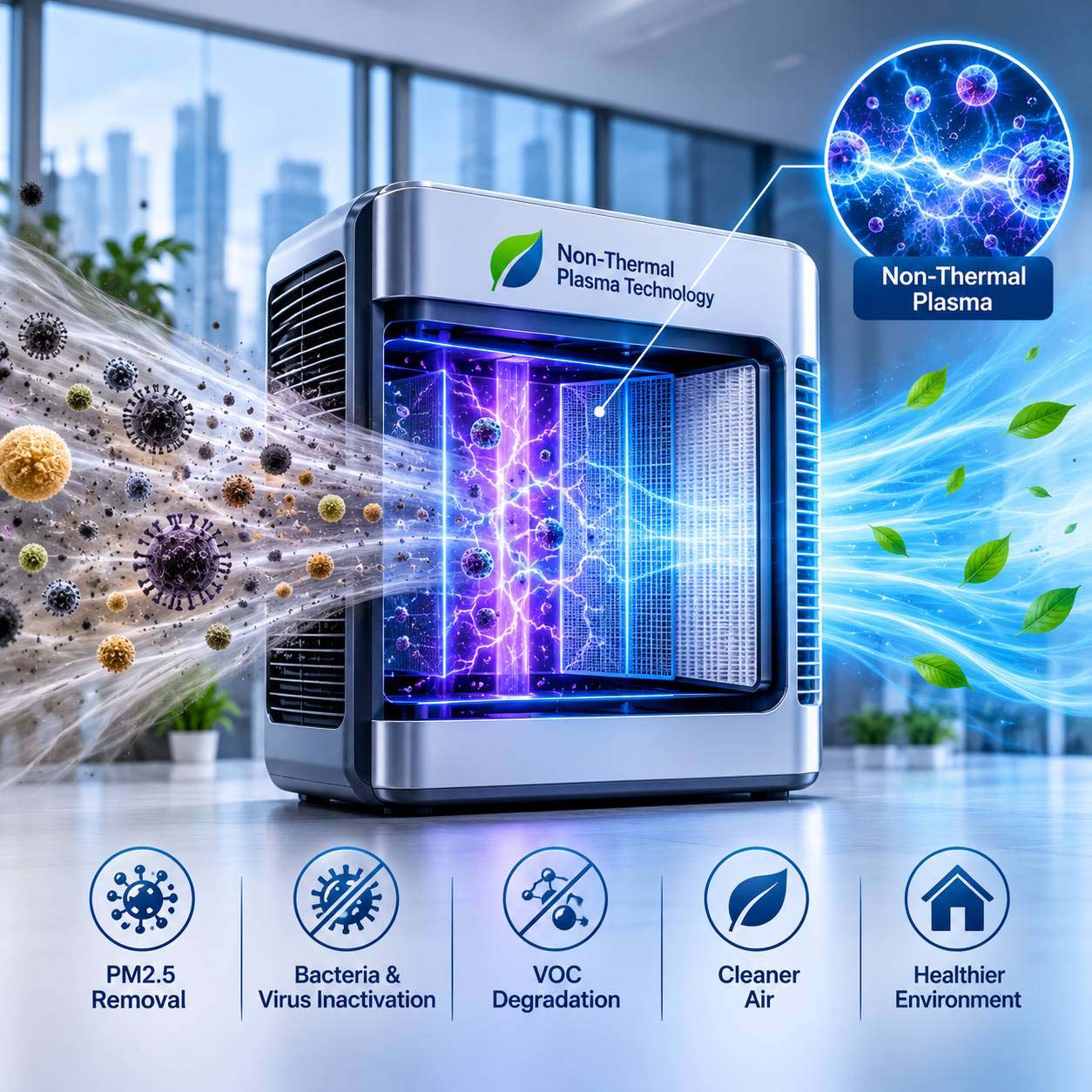
Experiments were conducted to measure the particle collection and removal efficiencies of a non-thermal plasma air filtration system (PFS). This system utilises a uniform and high intensity electric field to produce low-medium energy electrons, which in turn can charge particulate matter (PM) that passes through the field, potentially causing them to agglomerate and be more readily captured by conventional porous media filters. The experiments comprised of single-pass efficiency measurements and smoke recovery tests, where in both cases the particle count across the size range of 0.3 µm to 10 µm was measured. The results show that when the PFS is paired with a conventional MERV13 post-filter, the particle collection efficiencies exceeded 99.95% for all measured particle sizes for filter face velocities < 1 m/s. When the post-filter was removed, the minimum efficiencies reduced to 76.98%. The results also show that the PFS set
at a flow-rate of 30 ach removed 99.8% of the smoke introduced into the room within 15 minutes.